
Having a full head of healthy hair is alluring. Women have been commended for their beautiful hair all the time, making them feel that it is one of the essential aspects of being a human being. Unfortunately, a lot of them do find their hair shedding due to various reasons including age, illness, and pollution.
Reasons may be many, but remember, none of them is strong enough to make you feel inferior. Hair fall is a commonly observed condition which can be dealt with through dermatologist assistance. There are plenty of treatments available that can help people with excessive hair fall. The possibility of hair transplant for women is one such treatment that has awakened interest in most of the population who are eager to sport beautiful hair once again.
Facts About Hair Transplant for Women
 A surgical procedure that implants hair follicles on the bald areas is known as a hair transplant. However, it is more common in males than in women. The process is slightly more challenging for women as their balding pattern does not mimic that of men. Females observe thinning and shedding of hair in diverse parts of the scalp in sharp contrast to that of males where hair from the back and sides can be easily used for transplant.
Best Candidates for Hair Transplant for Women
 The areas that retain hair follicles can be used as a source of hair for transplants. However, women do not have stable donor sites. Hair follicles from such sites are likely to be shed along with other hair. Not all women can be treated via hair transplant, therefore. Statistics reveal that only about 2% – 5% of patients are advised to undergo the procedure for hair transplant. Doctors recommend transplants for women who have lost their hair due to the following reasons:-
- Patients with traction alopecia or hair loss due to pulling of hair on account of following faulty hairstyles.
- Patients with thinning of hair at certain spots after undergoing cosmetic surgery.
- Women suffering from the male type of baldness.
- Seborrheic dermatitis
- Burn patients and patients who have been subject to other kinds of physical trauma.
- Women diagnosed with Alopecia Marginalis with hair gradually receding from the hairline.
Procedure for Hair Transplant in Women
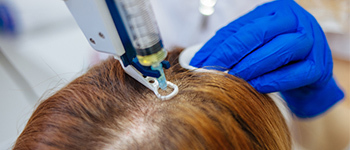 The procedure is usually done in a clinic under controlled conditions. The right candidate for hair transplants is treated by the concerned dermatologist making the final decision about the kind of procedure to be followed. The scalp, especially the area for receiving hair follicles, is cleaned thoroughly by giving the patient local anaesthesia to numb it.
Here are some of the prominently performed hair transplant procedures.
Follicular Unit Strip Surgery (FUSS) involves the following steps:-
- A narrow strip of skin measuring between 6 – 10 inches is removed from the ear end of the head. The incision is closed with the aid of sutures.
- The strip is then divided carefully into tiny portions, each containing a single or a few hair follicles. The hair is chosen carefully so that each strand matches the quality and colour of the surrounding hair growing in the thin or bald area.
Follicular Unit Extraction (FUE) includes:-
- The team of dermatologists will remove hair follicles from the shaved area of your scalp by picking them one by one.
- Both types of procedures take an identical turn from this point with the chosen hair follicles being grafted tightly into the required area of the scalp. The entire procedure for hair transplant will involve 6 to 8 hours at the most. However, doctors may decide to redo the process at a later date if the procedure is not successful.
Hair Transplant for Women: Recovery Process
 While getting a hair transplant is not essential, several individuals do it to regain their confidence. The actual process is a painless one, as you are sure to be anesthetized. Do not expect miracles, however. Like all surgeries, a hair transplant will not give you immediate results. You may want to look away from the mirror and concentrate on other things for a few days. However, your scalp is sure to be a little tender for the first few days immediately after the surgery. You would also need to retain the bandages to protect your scalp. Feel free to return to work within a week of the surgery. You may need to consume prescribed antibiotics to keep infections at bay.
Do not be alarmed to find the transplanted hair falling after 2 to 3 weeks. There will be a spurt of hair growth in the bald/thin spot with the hair gradually covering the area within nine months or so.
Are There Any Long Term Effects?
You do not have to worry about the new hair growth continually. Forget about it and comb your hair in the same fashion that you are used to. You can take proper care by washing the hair and oiling it as and when necessary. Moreover, go ahead and keep it trimmed neatly to improve your appearance. The newly transplanted hair will not be evident at all. The results will last a lifetime. Relax and enjoy your crowning glory!
Complications/Side Effects of Hair Transplant
 Hair transplant for women is usually a safe procedure with minimal complications. However, a few patients may experience the following side effects of hair transplant after days or weeks of a successful transplant. However, you can get these effects addressed by your dermatologist and how they occur.
- Shedding of hair –
 The transplanted hair will fall with new hair growth within a few days. Some of the existing hairs may shed due to shock after the surgery.
- Bleeding –
There may be some nicks and cuts on the scalp resulting in bleeding. The dermatologist will prescribe medicines to minimise blood loss.
- Pain –
Most doctors prescribe pain-reducing medications after the surgery to keep the associated pain under control.
- Infections –
It is essential to take antibiotics for reducing the risk of infections after a hair transplant.
- Itching –
Scabs are bound to form on the site of transplant that leads to intense itching. It is advisable to spray a medicated solution to stop it instead of scratching the area continuously.
- Scarring –
There will be some scarring of the scalp due to incision of specific areas. However, this can be managed with proper hair styling.
- Hiccups –
A few patients may have hiccups after the surgery. It is a rare condition that does not need any treatment for it vanishes within two days.
 The transplanted hair will fall with new hair growth within a few days. Some of the existing hairs may shed due to shock after the surgery.
 There may be some nicks and cuts on the scalp resulting in bleeding. The dermatologist will prescribe medicines to minimise blood loss.
 Most doctors prescribe pain-reducing medications after the surgery to keep the associated pain under control.
 It is essential to take antibiotics for reducing the risk of infections after a hair transplant.
 Scabs are bound to form on the site of transplant that leads to intense itching. It is advisable to spray a medicated solution to stop it instead of scratching the area continuously.
 There will be some scarring of the scalp due to incision of specific areas. However, this can be managed with proper hair styling.
 A few patients may have hiccups after the surgery. It is a rare condition that does not need any treatment for it vanishes within two days.
Hair transplants in both men and women can help in improving the appearance and restoring self-confidence. However, it is a surgical process that involves some risks. Be sure to discuss it with a competent dermatologist and visit https://www.skinandhairacademy.in/article/hair-transplant-in-men-and-women for more information.